[Quanzhou, China – October 24, 2026] As global food-contact material regulations become stricter and tableware factories accelerate automation upgrades across Asia, Europe and North America, **melamine granules** are quickly transforming from a niche alternative into a mainstream thermosetting raw material for melamine tableware production. Compared with conventional fine melamine moulding powder, this granular-form melamine compound solves long-standing pain points in workshop operation, material waste and molding consistency, making it highly sought after by export-oriented dinnerware manufacturers, hotel catering suppliers and children’s tableware OEMs.
Melamine granules are pre-compounded melamine-formaldehyde molding compound processed into uniform granular particles, formulated with refined alpha-cellulose filler, food-grade pigment and curing agent under controlled reaction conditions. The core chemical matrix remains the same as classic A5 food-grade melamine powder, retaining excellent heat resistance, boiling water resistance, scratch resistance and surface gloss after compression molding. The biggest difference lies in its physical form: the granular structure drastically reduces airborne dust during feeding, conveying and batching in automated hydraulic press workshops. For factories running continuous, high-volume molding lines, low-dust melamine granules bring two immediate benefits: cleaner production environments that meet occupational health standards, and far less material loss caused by powder floating and dispersion. Many plant managers report that switching from powder to melamine granules cuts raw material waste by 5% to 12% annually while simplifying equipment cleaning and maintenance schedules.
Molding stability is another decisive advantage that pushes buyers to test and adopt melamine granules. Fine melamine powder often causes bridging, arching and uneven feeding inside hoppers, leading to inconsistent material weight in each mold cavity, bubbles, surface pinholes and defective finished tableware. Granules feature consistent particle size and free-flow properties, supporting stable, repeatable dosing for both semi-automatic and fully automatic compression molding systems. Under standard molding parameters of 155–175°C and molding pressure between 15–30 MPa, melamine granules fill mold cavities evenly, deliver stable shrinkage rates, and greatly lower reject rates for decal-printed plates, bowls, trays and cutlery. This reliability is critical for export orders requiring uniform colour, texture and surface quality across tens of thousands of pieces.
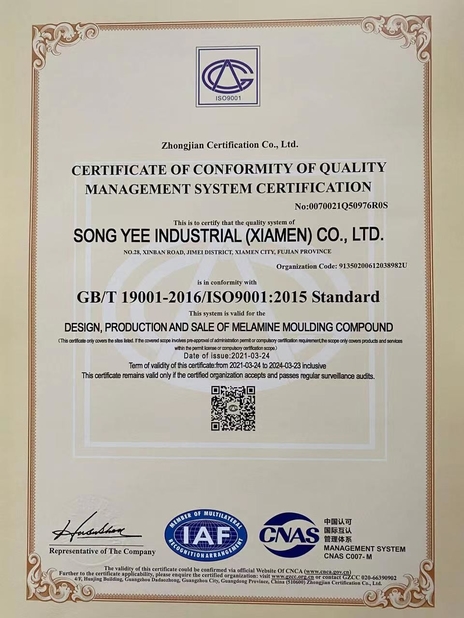
Safety compliance stays at the centre of procurement decisions for food-contact melamine materials. Qualified food-grade melamine granules are strictly controlled for melamine and formaldehyde migration limits, fully aligned with EU Regulation 10/2011, US FDA 21 CFR 177.1460, German LFGB and China GB 4806.7 standards. Each batch can support third-party SGS testing and complete traceability documentation, which is essential for exporters facing tightened customs inspection and RASFF notification risks in European markets. In recent years, multiple border detentions and product recalls of melamine ware have been triggered by excessive formaldehyde migration, pushing sourcing teams to shift focus from low unit price to verified formulation stability. Low-migration melamine granules with certified test reports help tableware brands avoid costly shipment hold-ups and reputational damage.
Customization capability further expands application scenarios for melamine granules. Manufacturers supply custom colour matching according to Pantone codes, from solid white and neutral tones for hotel dinnerware to bright, kid-safe colours for children’s tableware sets. Gloss, semi-matte and matte surface grades are available to satisfy different brand styles. Besides tableware, special grades of melamine granules can also be used for electrical insulation components, toilet seat panels and gaming accessories, though food-contact A5 grade remains the largest and fastest-growing segment.
Industry analysts tracking the amino molding compound market note that demand for melamine granules is growing faster than traditional melamine powder, driven by two overlapping trends: automation transformation among medium and large melamine ware factories, and rising consumer and regulatory scrutiny over food-contact chemical migration. While granular melamine compound carries


 Uw bericht moet tussen de 20-3.000 tekens bevatten!
 Dutch